
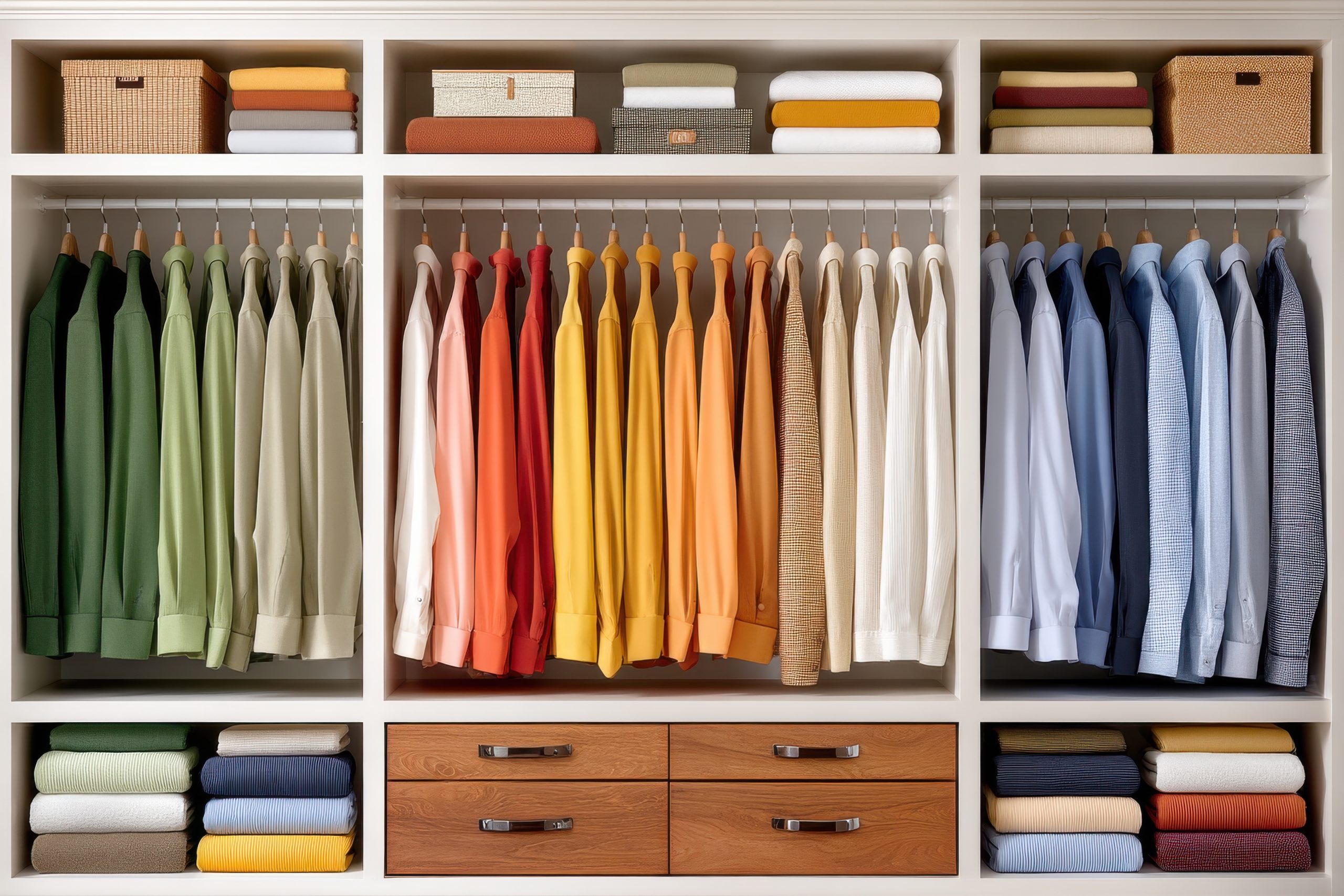
 There’s a particular kind of satisfaction that comes from opening a closet door and seeing color flow from one end of the rod to the other, with reds sliding into oranges, blues fading into violets, and everything exactly where your eye expects it to be.
If you’ve ever wondered how stylists and the most enviable closets pull this off, the answer is usually some version of the ROYGBIV method, which is essentially organizing your wardrobe in the same order as the colors of the rainbow: Red, Orange, Yellow, Green, Blue, Indigo, Violet.
It sounds simple, and, at its core, it is. But there’s a right way to do it, a few useful tricks for handling items that don’t fit neatly into a rainbow, such as an animal print blouse, and an honest truth about why some closets hold a color-coordinated system beautifully while others fall apart within a month. In this blog, we’ll cover it all here, including how a well-designed closet system makes the method dramatically easier to maintain.
Why Color-Coordinating Your Closet Actually Works
It Makes Getting Dressed Faster
Your brain processes color faster than it processes categories or labels. When your clothes are grouped by color rather than scattered by whenever-you-hung-them-up, you’re not scanning tag by tag or sleeve by sleeve; you’re taking in the whole spectrum at a glance and zeroing in on exactly the shade you had in mind. That matters most on a rushed morning: instead of digging through the closet piece by piece, you can pull a full outfit together in the time it takes to glance across one section. Grouping by color also has the happy side effect of making outfit combinations you’d never have noticed suddenly obvious, because the pieces that work together are already sitting next to each other.
It Reveals What You Actually Own
Line up every navy top you own in one place, and you’ll probably discover you have eleven of them. This is the overlap effect, and it’s one of the most useful side benefits of color organization: duplicates and forgotten pieces become impossible to miss when they’re standing shoulder to shoulder in the same color block. That visibility naturally supports decluttering, and it tends to save money over time simply because you stop accidentally buying the same sweater twice.
It Makes Your Closet a Space You Want to Use
There’s a real psychological lift that comes from opening a closet that looks intentional. A color-coordinated closet feels calm and in control in a way a jumbled one never quite does, and putting things back where they belong becomes almost automatic once “where they belong” is obvious. That effect is amplified by a closet built for the purpose, with consistent rod heights, thoughtful spacing, and good lighting that all make a color-organized wardrobe look even more polished.
Before You Start: Prep Your Closet for Color Organization
Step 1: Declutter First
Color-coordinating a closet full of clothes you don’t wear doesn’t solve the problem; it just makes it prettier. Before you sort a single item by hue, go through everything on the rod and keep only what actually fits, is in good condition, and has been worn in the past year. Anything that doesn’t make the cut should leave the house, not just the closet. Donate these items rather than box them up for storage you’ll never revisit.
Step 2: Separate by Garment Type Before Sorting by Color
The most successful color-coordinated closets use two axes, not one: garment type first, then color within each type. That means grouping shirts, blouses, and sweaters together as one category; pants, skirts, and denim as another; then dresses and jackets each getting their own zone. Only once those categories are established do you arrange by color inside each one. Skip this step and mix garment types within a color group, and even perfectly matched colors will look chaotic. A red blouse, a red skirt, and a red jacket hanging in a row reads very differently than the same three pieces scattered by category with only their color in common. A closet with dedicated zones built in for each garment type makes this two-axis system permanent, rather than something you have to reinvent every time you tidy up.
Step 3: Pull Everything Out and Sort on the Bed
Resist the urge to color-sort in place. A full empty-out lets you physically group colors together before anything goes back on a rod, and sorting on a flat surface like the bed or the floor gives you a true, at-a-glance view of your whole wardrobe. While you’re at it, snap a quick photo of the closet in its “before” state; it’s motivating once the “after” is finished and useful for spotting gaps in your current system.
The ROYGBIV Method: Step-by-Step
What Is ROYGBIV?
ROYGBIV stands for Red, Orange, Yellow, Green, Blue, Indigo, and Violet, which is the sequence of colors found in a rainbow and across the visible light spectrum. It works so well as a closet-organizing framework because it’s intuitive and universally recognizable. Your eye already knows this order, so a closet arranged this way reads as effortless rather than arbitrary. ROYGBIV should be considered a framework rather than a rigid rule, though, because real wardrobes have edge cases, which we’ll walk through how to handle a little further down.
R — Red
True red, burgundy, wine, rust, coral, and deep rose are colors that all belong in this section. As a placement tip, let warmer, orange-leaning reds drift toward the orange section and keep cooler reds like berry and wine at the very start of the spectrum. Red tends to be one of the smaller categories in most wardrobes, so group it with confidence and move on.
O — Orange
Burnt orange, terracotta, peach, amber, and a warm tan live here. Orange and red overlap naturally at the edges, so lean on your eye rather than a strict rule when a piece feels like it could go either way. Earth tones like camel and tan often sit most comfortably here, or right at the transition into yellow.
Y — Yellow
Mustard, gold, butter, and cream all fall into the yellow section, along with warm off-whites. Most stylists place warm cream and off-white here rather than lumping them in with true white and other neutrals. Like red, yellow is usually a smaller category, but it plays an important role in the visual flow between orange and green.
G — Green
Olive, sage, forest, emerald, mint, and khaki all belong here, and green is often one of the larger sections in a color-coordinated closet. Within the section, sub-sort warm to cool, from olive through to mint, for an even cleaner gradient. Olive and khaki frequently bridge the gap between yellow and green, so place them by eye rather than by strict rule.
B — Blue
Navy, cobalt, royal, sky, denim, and chambray all live in the blue section, which is almost always the largest single category in a wardrobe. Sub-sort from dark to light for the cleanest visual result. If you own a lot of denim, it deserves its own dedicated section within blue, or even its own separate zone if your wardrobe runs large.
I — Indigo
Deep blue-purple, periwinkle, and true indigo fall here, though most wardrobes don’t have a large indigo collection on their own. If that’s true for you, don’t force a distinct zone; let indigo blend naturally into the transition between blue and violet instead.
V — Violet
Lavender, lilac, purple, plum, and mauve round out the spectrum. As violet transitions toward neutrals, place mauve and dusty purple at the tail end, then move into pink and neutral territory. Pink technically isn’tpart of ROYGBIV, but fits naturally at the end of the spectrum for most wardrobes.
Handling the Hard Cases: Neutrals, Prints, and Everything In Between
Where Do Neutrals Go?
White, off-white, ivory, gray, charcoal, black, and beige don’t belong in the rainbow itself, so you have two solid options: the bookend method, which places light neutrals at one end of the closet and dark neutrals at the other, or the neutral block, which groups all neutrals together before or after the spectrum. For most wardrobes, we recommend the bookend method because it frames your color spectrum instead of interrupting it.
What About Prints and Patterns?
Sort printed items by their most dominant or background color. If a print splits evenly between two colors, go with whichever reads most strongly from a few feet away. If prints make up a large share of your wardrobe, a separate prints zone placed after your neutrals can work just as well.
Multicolor Items and Statement Pieces
Truly multicolor pieces, like color-blocked items, rainbow prints, and bold graphics, can be grouped by dominant color or pulled into a small statement section of their own. Placing them at the very end of the spectrum, or in a dedicated display spot, works especially well in a walk-in closet where styling is part of the design.
Seasonal and Off-Season Items
Color coordination works best when it’s applied to your active, in-season wardrobe rather than everything you own. Off-season pieces are stored separately, in bins, on upper shelves, or in a secondary closet, so they don’t dilute the main color flow. A closet system built with dedicated seasonal storage makes this separation automatic, rather than something you have to engineer yourself.
Folded Sweaters and Stacks
ROYGBIV can also apply to sweaters, knits, and anything else you fold onto a shelf. The difference is that instead of a hanging line, you’re building a stack. Arrange folded items light to dark within each color group, and keep stacks short, with four to six pieces max, so you’re not digging through a pile to find the one piece you want at the bottom. If a shelf spans multiple colors, treat it exactly like the rod. The color order carries straight across from hangers to shelves so the entire closet reads as one continuous system rather than two separate ones.
Shoes, Bags, Belts, and Accessories
Clothing isn’t the only thing that can follow a color order. Shoes generally do better when organized by type and height first, since that’s what actually determines how they’re stored, but within each type, arranging left to right by color keeps the same visual logic going. Belts and scarves are small enough to hang on hooks or coil in a shallow drawer sorted by color family, and bags tend to work best grouped by size with color as the secondary sort, since a bag’s shape usually matters more than its shade when you’re deciding where it lives. None of this is to be exact, because accessories are lower-stakes than the main color spectrum, and how far you take it really comes down to personal preference and how much shelf or drawer space you have to work with.
How to Keep Your Color-Coordinated Closet Looking Great
The 30-Second Return Rule
Every item that leaves the closet gets returned to its exact color zone, not just hung wherever there happens to be space. This one habit is essentially the entire maintenance system. The thirty seconds it takes to put something back correctly saves you from an hour-long re-sort a few weeks later.
Consistent Hangers Make a Huge Difference
Mismatched hangers create visual noise that undercuts even a perfectly color-sorted closet. Switching to a single hanger style makes a noticeable difference, and a well-designed rod system keeps everything at the same height for a clean, cohesive look. Slim velvet hangers are a favorite, and neutral hangers in black, white, or wood tend to work best since they hold clothes securely without competing with the colors hanging on them.
Skip the Labels and Let the Color Do the Work
One instinct people have when they set up a new system is to reach for a label maker, but a true color-coordinated closet mostly doesn’t need one since the color order is the label. The exception is when applied to a shared closet. If more than one person uses the space, a few small tags marking where each color zone starts can keep everyone sorting the sme way, especially in the first few weeks before the system becomes second nature.
Update the Sort When You Shop
Fold new purchases into your color system before they ever make it into the closet, rather than after they’ve already been worn and mixed in with everything else. Use each new item as a natural trigger to reassess what’s already there. Something new comes in; something worn out or unused goes out.
The Right Closet Makes All the Difference
Color coordination is hardest to maintain in a closet that’s overcrowded or underbuilt. When there isn’t enough rod space, everything gets compressed, and color zones start to collapse into each other no matter how carefully you sorted them the first time. A custom closet designed around how you actually get dressed, with the right amount of hanging space, proper rod spacing, and dedicated zones for each garment type, is what turns the ROYGBIV method from an aspiration into something that simply works, day after day.
ROYGBIV Variations Worth Trying
Light to Dark Within Each Color
Within each color group, arrange pieces from lightest shade to darkest. For example, within the blue section, start with sky blue fading into cobalt, then navy. This sub-sort creates a particularly polished gradient effect that photographs beautifully and is intuitive to navigate at a quick glance.
The Reverse ROYGBIV (Dark to Light)
Some closets work better when starting with the darkest neutrals, like black or charcoal, moving through the spectrum in reverse, ending with white and light neutrals. This variation tends to suit wardrobes that skew dark overall, or closets where the natural entry point sits on the opposite side.
Category-First, Then ROYGBIV
Organize by garment type first, like tops, bottoms, and dresses, then apply ROYGBIV within each category. For most wardrobes, this is the most practical version of the method, since it keeps the functional logic of category grouping while layering in the visual clarity of color order.
None of these variations is objectively correct. Which one fits best comes down to personal preference, the size of your wardrobe, and how you tend to shop and get dressed. Try the standard version first, live with it for a couple weeks, and adjust from there.
Frequently Asked Questions About Color-Coordinating a Closet
What is the ROYGBIV method for closets?
ROYGBIV is a closet organization method that arranges clothing in rainbow order (Red, Orange, Yellow, Green, Blue, Indigo, and Violet) with neutrals and prints handled separately. It creates an intuitive closet that’s faster to shop from and easier to maintain than organizing by category alone.
Where do white and black clothes go in a color-coordinated closet?
Most organizers use the bookend method, placing light neutrals like white and ivory at one end of the closet and dark neutrals like black and charcoal at the other. This frames the spectrum rather than interrupting it.
How do I organize patterned or printed clothes by color?
Sort printed items by their most dominant or background color. If a print is evenly split between two colors, place it by whichever color reads most strongly from a few feet away. A dedicated prints section after neutrals also works well for print-heavy wardrobes.
Does color-coordinating your closet actually save time?
Yes. Your brain processes color faster than text or category labels, so a color-organized closet lets you scan and choose an outfit in seconds rather than searching hanger by hanger. It also surfaces outfit combinations you might otherwise miss.
What type of hangers are best for a color-coordinated closet?
Slim, uniform hangers in a neutral color create the cleanest look and maximize hanging space, with velvet styles being particularly popular. Mismatched hangers introduce visual noise that undermines even a well-sorted color system, so consistency matters more than the specific style you choose.
How do I maintain a color-coordinated closet long-term?
An overcrowded closet is the most common reason color systems break down. Follow the 30-second return rule: put every item back in its exact color zone immediately after wearing it. Reassess your sort each time you shop, and make sure your closet has enough rod space and dedicated zones.
Build the Closet That Makes This Method Work
The ROYGBIV method is simple, effective, and honestly kind of fun once you get going, but it works best in a closet that has enough rod space, the right zones, and storage built around how you actually get dressed. If your current closet is fighting you every day, that’s usually a storage challenge more than a sorting problem.
At NewSpace, we design fully custom closets for homeowners nationwide. If you’re serious about a closet that looks as good as it functions, we’d love to help you get there. Schedule a free design consultation and let’s talk about what a closet built for your wardrobe and lifestyle could look like.


